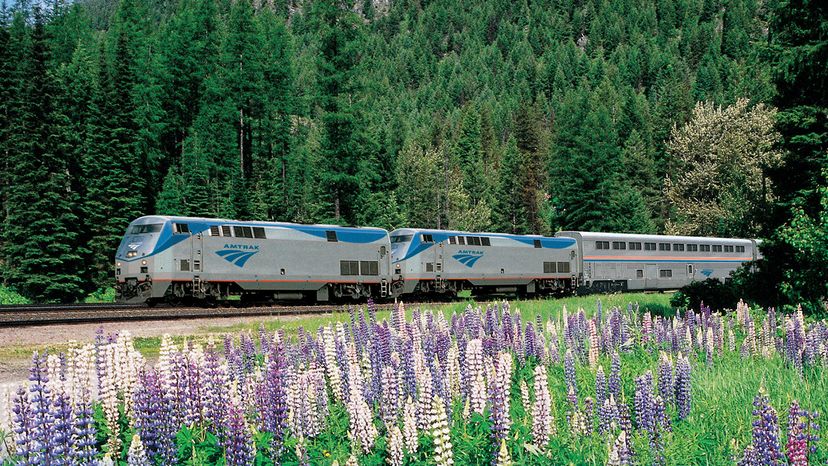
Diesel engines are used in many types of vehicles, including locomotives. Diesel engines have a fuel efficiency 20 percent greater thermally than a gas engine. This means a 20 percent increase in fuel economy and therefore lower operating costs than those of a gas engine. Diesel engines also last longer than gas engines because they run at a much slower rpm (revolutions per minute) rate than gas engines do.
The hybrid diesel locomotive is an incredible display of power and ingenuity. It combines some great mechanical technology, including a huge, 12- to 16-cylinder, two-stroke diesel engine, with some heavy-duty electric motors and generators, throwing in a little bit of computer technology for good measure.
The locomotives weigh between 100 and 200 tons (91,000 and 181,000 kilograms) and are designed to tow passenger-train cars at speeds of up to 125 miles per hour (200 kph). Siemens' modern engines produce up to 4,200 horsepower, and the generator can turn this into almost 4,700 amps of electrical current. The drive motors use this electricity to generate around 60,000 lb-ft of torque. There is also a secondary diesel engine and generator to provide electrical power for the rest of the train. This generator is called the head-end power unit, producing between 500 and 700 kilowatts (kW) of electrical power.
This combination of diesel engine and electric generators and motors makes the locomotive a hybrid vehicle. In this article, we'll start by learning why locomotives are built this way and why they have steel wheels. Then we'll look at the layout and key components.
Why Hybrid? Why Diesel?
The main reason why diesel locomotives are hybrid is because this combination eliminates the need for a mechanical transmission, as found in cars. Let's start by understanding why cars have transmissions.
Your car needs a transmission because of the physics of the gasoline engine. First, any engine has a redline — a maximum rpm value above which the engine cannot go without exploding. Second, if you have read How Horsepower Works, then you know that engines have a narrow rpm range where horsepower and torque are at their maximum. For example, an engine might produce its maximum horsepower between 5,200 and 5,500 rpms. The transmission allows the gear ratio between the engine and the drive wheels to change as the car speeds up and slows down. You shift gears so that the engine can stay below the redline and near the rpm band of its best performance (maximum power).
The five-to-10-speed transmission on most cars allows them to go 110 mph (177 kph) or faster with an engine-speed range of 500 to 6,000 or higher rpm. Diesel engines have a much slower operating speed than gasoline, and that goes double for the massive ones used in locomotives. The large displacement diesel engine tops out at about 2,100 rpm, or lower. With a speed range like this, a locomotive would need 20 or 30 gears to make it up to 110 mph.
A gearbox like this would be huge (it would have to handle 4,200 horsepower), complicated and inefficient, and create a possible point of mechanical failure. It would also have to provide power to four sets of wheels, which would add to the complexity.
By going with a hybrid setup, the main diesel engine can run at a constant speed, turning an electrical generator via driveshaft. The generator sends electrical power to a traction motor at each axle, which powers the wheels. The traction motors can produce adequate torque at any speed, from a full stop to 125 mph (200 kph), without needing to change gears.
Why Diesel?
Diesel engines are more efficient than gasoline engines, and when moving literal tons of freight or passengers, efficiency is paramount. Train manufacturer CSX estimates that their fleet moves 1 ton (0.9 metric tons) of cargo an average of 492 miles (791 kilometers) per 1 gallon (4 liters) of fuel, making locomotives four times as efficient as moving goods on roadways. Diesel-electric systems are also five times more efficient than the old steam engine locomotives, which is why diesel entirely replaced steam in the early 20th century.
Diesel also has seen some competition from fully electric trains, which pull directly from a power grid as they drive. This method is several times more efficient than burning any kind of onboard fuel to produce energy. Electric locomotives are especially popular in Europe and Asia, but the changeover in the U.S. has been slow. Probable causes are that electric trains require their own specialized infrastructure to operate, and old locomotives can be in service for multiple decades before retirement. For the time being, diesel remains the standard. A few passenger railways have however been electrified in the States, including Amtrak's northeast corridor and California commuter rail.
Ever wonder why trains have steel wheels, rather than tires like a car? It's to reduce rolling friction. When your car is driving on the freeway, about 4-7 percent of its potential energy is lost to the rolling resistance of the tires. Tires bend and deform a lot as they roll, which uses a lot of energy.
The amount of energy used by the tires is proportional to the weight that is on them. Since a car is relatively light, this amount of energy is acceptable (you can buy low rolling-resistance tires for your car if you want to save a little gas).
Since a train weighs thousands of times more than a car, the rolling resistance is a huge factor in determining how much force it takes to pull the train. The steel wheels on the train ride on a tiny contact patch — the contact area between each wheel and the track is about the size of a dime.
By using steel wheels on a steel track, the amount of deformation is minimized, which reduces the rolling resistance. In fact, a train is about the most efficient way to move heavy goods.
The downside of using steel wheels is that they don't have much traction. In the next section, we'll discuss the interesting solution to this problem.
Traction
Traction when going around turns is not an issue because train wheels have flanges (projecting rims around the wheels) that keep them on the track. But traction when braking and accelerating is an issue.
A locomotive can generate more than 60,000 lb-ft of torque. But in order for it to use this torque effectively, the eight wheels on the locomotive have to be able to apply it to the track without slipping. The locomotive uses a neat trick to increase the traction.
In front of each wheel is a nozzle that uses compressed air to spray sand, which is stored in two tanks on the locomotive. The sand dramatically increases the traction of the drive wheels. The train has an electronic traction-control system that automatically starts the sand sprayers when the wheels slip or when the engineer makes an emergency stop. The system can also reduce the power of any traction motor whose wheels are slipping.
Now let's check out the layout of the locomotive.
The Layout: Main Engine and Generator

Nearly every inch of the 54-foot (16.2-meter) locomotive is tightly packed with equipment.
Main Engine and Generator
The giant two-stroke, turbocharged engine and electrical generator provide the huge
amount of power needed to pull heavy loads at high speeds. Cummins' locomotive
engine weighs over 24,000 pounds (10,886 kilograms). The generator and electric
motors add more mass on top of that. We'll talk more about the engine and generator
later.
Cab
The cab of the locomotive rides on its own suspension system, which helps isolate
the engineer from bumps. The seats have a suspension system as well. Inside the
cab is a small working space with only a few seats. Usually the cab is only occupied
by an engineer and a conductor.


